Pushing the Establishment... and Yourself
I don't know if this is really a Colin Powell quote, but if it is, my respect for him went up dramatically:
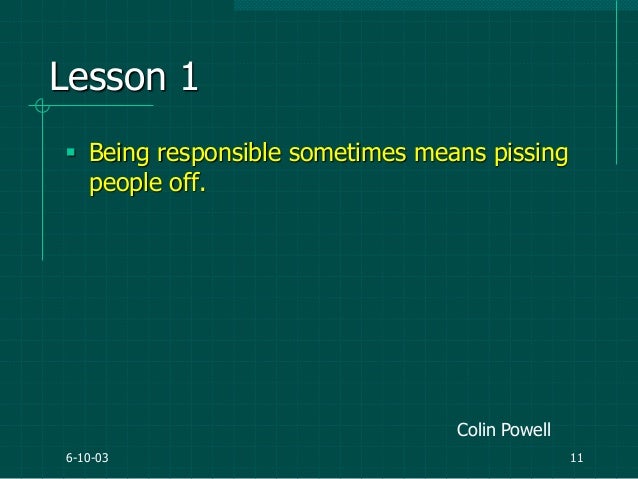
In my pubescent years, and to a lesser extent today, I'd purposely piss people off just watch their reactions. Perhaps not one of my greatest strengths, playing devil's advocate is just part of my personality - particularly with authority figures who use their status to try and make people drink the cool-aid.
Some of my professors/teachers loved the challenge, most would just get annoyed.
When I was in 10th grade, my English teacher was a super-hardcore environmentalist who wouldn't stop talking about the destruction of the Amazon Rainforest. We spent months as a captive audience, forced to listen to her spiel. It was really annoying. We had to write a final paper at the end of the year on how to save the Rainforest. As petty revenge, I wrote mine on why we should destroy it.
I got a B+. One of the proudest moment of my life.
Wow, I need to get out more - hit a club, go camping, become more active on Tinder.
Anyways, besides being an opportunity to reminisce about my days as a young whippersnapper as well as a means to tout my own horn a bit, I do have a point to make:
If your not questioning your own conclusions, data, and thought processes, you will stagnate. Stagnating is worst than making bad conclusions. It means your not learning, and thus will never improve. If your not improving, its time to retire.
Wrong Conclusions, Yet Good Analysis?
I had a conversation (okay, a friendly argument) with a fellow analyst about whether good analysis can be wrong. That is, if all data suggests a certain conclusion, should the analyst be blamed if said conclusion turns out to be wrong due to bad data and/or unknown variables.
My friends believed: Yes, it is still good analysis because it is unreasonable to expect an analyst to always be right. By definition, analysts make conclusions based on imperfect data.
A year ago, I would have agreed with him. Now, I'm not so sure.
If you start to think in terms of its okay to be wrong when given bad information, your accepting that you can't do any better. Rather than seeing it as "good analysis, bad data," it should be "How might I have noticed that my data was wrong?" or "What other data should I have looked for that might have prevented this wrong conclusion?"
Embrace Failure
Bad conclusions are never acceptable. All it means, is your not asking the right questions. However, the only thing worse than stagnating, is asking so many questions that you never make a conclusion. Have some cahones. You'll sometimes be wrong - suck it up, and get better.
The best analysts and organizations respect and learn as much as possible from failure. Embrace it, don't try and justify it. Waving dirty underwear around may not be be the most politically savvy thing to do, but at least you don't have to look into the mirror knowing deep inside your in denial. Complaining about incompetency and failed processes is a good thing - competent organizations value complaining... in moderation. Its what promotes evolution and positive change. Do you think the Civil Rights Movement changed America by "going with the flow?"
The trick is to figure out how to be a positive complainer - one that does it to improve things, and not just poison the work environment.
Disclaimer: Hmmm... I'm not really as much of a pain in the butt as this post suggests.

No comments:
Post a Comment