Monday, November 7, 2016

Who I am Voting For....

I made this awesome cartoon to show who I'm going to vote for!


My artistic genius even surprises me sometimes...

Update: I spelled "racist" wrong =(.

Who I am Voting For....

I made this awesome cartoon to show who I'm going to vote for!


My artistic genius even surprises me sometimes...

Thursday, October 27, 2016

US-Filipino Relations and China

This article does a good job explaining the situation regarding U.S.-Filipino Relations and China. Much more detailed than I would do in a blog post.

However, I want to stress a few points:

President Duterte strategy of flirting with China is potentially a pragmatic, calculated move. It reminds me of the Cold War where unaligned countries would play the U.S. and Soviets off each other to gain the best possible deals. Duterte may have judged that he can use the possibility of closer ties with China to get the U.S. to do more to support the Philippines.

Along the same line of thought, Duterte may have judged that if the U.S. doesn't step up its support to counter China, he might figure he should at least position the Philippines to benefit as much as possible from (unwillingly) being under China's sphere of influence.

Alternatively, President Duterte may just be a bit crazy, and/or perhaps has a personal issue with the U.S. His unusual behavior and unconventional diplomatic style leads me to believe a detailed leadership analysis could play a huge role in understanding intentions.

I think the article also does a good job of showing how Filipino public opinion regarding the U.S. and China is completely at odds with the President Duterte's rhetoric. Despite his popularity in the opinion polls, Filipinos are overwhelmingly pro-U.S., and I can't see the general population accepting a pivot towards China in the near future.

Also, the Filipinos speak English, not Chinese. This gives the U.S. a huge soft power advantage over China in the country.

Note: I'll come back and expand upon and clean this section up.

Wednesday, October 26, 2016

Job Search for the Generalist

I have been looking for "strategic alternatives" to my current employment for a while now, and I have discovered there is not much of a market for generalist, particularly at junior level positions. The algorithms used by online job applications to weed out the chaff are rarely impressed with the argument, "My wide array of interests and experiences position me well to specialize in whatever tasks required."

Truthfully, I don't blame the developers of these algorithms or recruiters. My argument is so abstract and intangible, it is a nightmare for statisticians to develop concrete indicators to output any value that provides a useful comparison between candidates. Think about it: how does a generalist go about proving they can thrive in a position despite having only a shallow understanding of the technical issues at hand?

Wednesday, August 3, 2016

WTF Venezuela

VIVA LA REVOLUTION!

Ah Venezuela... the most recent attempted at a socialist paradise. 

Also known as: the most recent attempted at a fundamentally flawed system. 

The Venezuelan Government's latest brilliant idea to... you know, make sure everyone doesn't starve, is using forced labor to increase food production.

Amnesty International reported: "The decree, officially published earlier this week, establishes that people working in public and private companies can be called upon to join state-sponsored organizations specialized in the production of food."

I talked to someone I know who grew up in the Soviet Union about Venezuela's food lines and forced labor initiative. He just laughed in a nostalgic manner, and said it reminded him of home. He also said it reminded him of why he got the heck out of the Soviet Union.

Monday, August 1, 2016

Classroom Environment

Prior to developing our analyst training program, I had the privilege of being sponsored for a full-time 10 week analyst training course to help us prepare curriculum.

 I found myself greatly disappointed.

The instructors covered a vast amount of information on virtually every major analysis discipline and topic. However, these well-meaning experts were so desperate to teach everything they thought was important, they forgot students might not be able to absorb it all in such a small span of time.

I calculated that my eyes glazed over roughly 5,000 PowerPoint slides in those 10 weeks. Unfortunately, the information overload resulted in me remembering very little.

As a result, I tell new instructors the worst thing they can do is drivel through hours of PowerPoint slides. Covering less information more thoroughly at a slower pace will insure important information sticks.

Our advice is to teach the core - see 'Like an Analyst" posts for specifics. In general, unless the job position is for something that requires years of specialized training (i.e. translator or highly technically oriented), new hires are almost always retrained by co-workers and mentors in the trenches to meet their specific needs.

Thursday, July 28, 2016

Ahhh the Weasel Word

What is a weasel word?

Merriam-Webster Dictionary defines it as: A word used in order to evade or retreat from a direct or forthright statement or position

Some examples of weasel words I see regularly:
  • Supports
  • Appears
  • Most
  • Almost all
  • Virtually
  • May
  • Possibly
Somewhat of a “third rail” for analysts, I have found that many instructors we hire side-step the issue of weasel words all together due to (in my opinion) the political ramifications and sensitivity of there use. The problem is that because analysis is by definition not fact, using weasel words are almost always required for analytical products (see how I used almost there?) At the same time, consumers of analysis tend to dislike weasel words because perfect information is preferable to conjecture when making tough decisions.

Thursday, July 14, 2016

"Context"... Like an Analyst?

I've been trying to think of a synonym for "Context" that still follows the nifty "Like an Analyst" theme. Using "Context" Like an Analyst simply doesn't make sense. Hmmm.... if you have any ideas, let me know. I think I need a verb.

Anyways, what does "context" mean? My favorite definition comes from the Merriam-Webster's dictionary:

Context: "The interrelated conditions in which something exists or occurs"

"Context" within the context (lol) of analysis can be summed up with the classic, yet to-vague-to-be-helpful saying: "see beyond the tree and into the forest." That is, understanding the broader strategic implications more localized analyses/data may influence or be influenced by. Context is particularly important for synthesizing the "why" when conducting analysis.

Tuesday, July 12, 2016

“Speak" like an Analyst - Part 2: Presenting

Our analyst training program splits the skill “Speak" like an Analysis (SLA) into two themes: Collaboration and Presentation

          1) Verbally collaborating with other analysts to produce products

          2) Presenting finished products to customers

This specific post focuses on Presentation:

Some analysts just have that natural charm and infectious enthusiasm that make them natural presenters. Fortunately for the rest of us, good presentations and oral briefings are easier to learn from an instructor than writing. In the finest tradition of working at a university, I’m much better at critiquing presentations given by student than giving one myself.

We first cover the basics: Watch your “ums,” plant your feet on the ground if you have a tendency to fidget, and whatever you do, don’t making something up - it’s likely to bite you in the bum at some point. If the audience asks a question you don't know the answer to, say something along the lines of "That is a great question, but I don't know the answer. I will definitely get back to you on that."

“Speak" like an Analyst - Part 1: Collaboration

Our analyst training program splits the skill “Speak" like an Analysis (SLA) into two themes: Collaboration and Presentation

       1) Verbally collaborating with other analysts to produce products

       2) Presenting finished products to customers

This specific post focuses on Collaboration:

Managers love the word "Collaboration." It is considered vitally important by much of the workforce, yet is hard to define. Therefore, saying one will increase collaboration is a safe promise any manager or analyst can make with little accountability. For example, if a manager were to promise they would expand their production capacity by 50% with additional funding, they are on the hook to meet that goal. If the manager were to promise they would increase collaboration by 50%, how does one argue they didn’t? 

Monday, July 11, 2016

"Write" Like an Analyst

As a disclaimer: I fully understand the irony of me talking about "Write" like an Analyst (WLA). This blog is an almost perfect example of what not to do - fluffy, tangents, opinions, personal pronouns, passive sentence, etc.

Our analyst training program focuses on science, technology, engineering, mathematics (STEM) students. As such, writing tends to not be an integral part of students' formal university education. It's a real shame since so many (if not most) technical jobs have a significant writing component. Analysts in particular tend to spend a lot of time writing briefs and reports.

WLA can be challenging, even for students in liberal arts majors with lots of writing experience, because it is very different style from what students are introduced to in English 101. When teaching WLA, we stress: Concise, Clear, and Professional.

Thursday, June 23, 2016

"Read" Like an Analyst

One of the first things I explain to new student analysts is that “Read" Like an Analyst (RLA) is very different than reading a novel on a lazy Sunday afternoon.

In technical analysis, metadata is critical – data that describes other data. We explain to students that understanding the biases and purpose of the writers of a product is essentially non-technical oriented metadata. Therefore, whenever we assign student analysts articles to read as part of RLA training, we challenge them to consciously consider not just what is written, but on who, where, when, etc., as well as consider what other cultural norms and contexts may add value to their understanding.

The most important questions we challenge students to always ask is: "Why did the author write said piece, and what does the author want the reader to take away from it?"

There is not much more to share on RLA. Once students are told what to look for, it just takes practice and constant vigilance to not take things at face value.

"'Think" Like an Analyst

"'Think" Like an Analyst (TLA) is probably the hardest to define Core Skill on our list. It includes concepts such as critical thinking, understanding one’s own limitations and biases, and analysis methodologies. TLA is annoyingly vague, illusive, and abstract, and as a result, we’ve frustratingly redefined this skill multiple times over the years. However, it is critical as it forms the foundation for all other Core Skills. It is often what separates the good analyst from the great.

Unfortunately, it is also one of the hardest to teach.

Many analyst training programs approach TLA by teaching structured analysis techniques (SAT) as part of alternative analysis training. While I won't go into detail on specific techniques, SATs are essentially formal reasoning methodologies that are designed to improve analysis. [1]

SAT proponents argue utilizing formal reasoning techniques is beneficial because they force analysts to see problem statements through different lens, help analysts realize their own biases, and perhaps most importantly (in my opinion), forces them to spend additional time considering counter-arguments.

SAT opponents argue that, depending on the technique, the process can be time consuming. In addition, analysts are an independent lot and may not appreciate nor work well when pigeon holed into using certain methods. Perhaps most controversial, too much structure can sideline creativity and intuition – for better or worse. 

Monday, June 20, 2016

Core Skills Every Analyst Needs

The most interesting project at my job I am currently involved with is developing and executing an analyst training program that prepares science, technology, engineering, mathematics (STEM) university students for analysis oriented careers.  Unusual for most training programs, we had few concrete objectives beyond training analysts.

We made a conscious decision early on to not specialize in any particular field or discipline. Instead, we are more interested in helping students develop a set of cross-disciplinary skills that are transferable to whatever employment they decide to pursue.

Our first step to develop curriculum was asking the fundamental question: “What does an organization look for in a new analyst?”

Monday, June 13, 2016

What the Heck is an Analyst?

I am one of the thousands of analysts that have choked on a date when asked what I do for a living. From my experience, analysts tend to stumble through a vague answer, eventually lamely ending it with some form of “I can’t talk about it.” It’s easy answer, and makes one look sexily mysterious. I, on the other hand, think this is often an excuse to cover up the truth – it’s frustratingly hard to define what an analyst actually does.

Sure you can give individual examples: “I figure out how radar systems work” or “I track counterfeit money.” However, what about analysis as a generic terms?

“I analyze things for a living.”

Not particularly helpful. It’s much easier to understand, for example, what a heart surgeon does:

“I perform heart surgeries for a living.”

The difficultly in defining what an analyst does is a key reason why it’s so hard to teach. What do you look for in a new analyst? Smart? Well versed on specific topics? Novel ideas? Creative? A good writer? Language or technical skills?

Critical skills for analysts are as broad as they are vague.

Thursday, December 10, 2015

Being Annoying = Win!

Wow, lots of incoherent drivel in this post - a little shameless self-promotion, a little philosophy, and some epic motivational material.

Pushing the Establishment... and Yourself

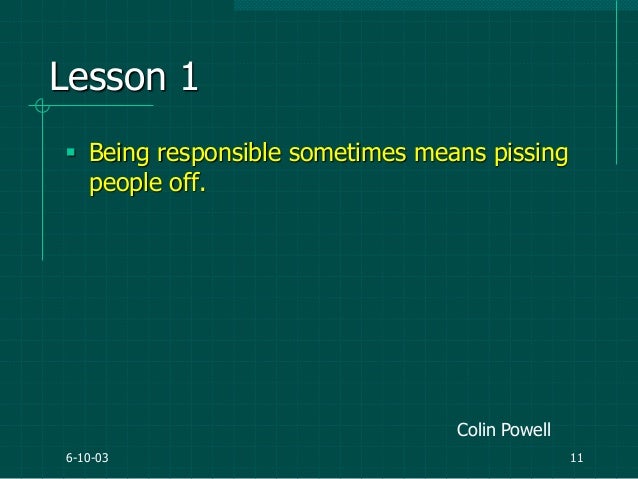
I don't know if this is really a Colin Powell quote, but if it is, my respect for him went up dramatically:


In my pubescent years, and to a lesser extent today, I'd purposely piss people off just watch their reactions. Perhaps not one of my greatest strengths, playing devil's advocate is just part of my personality - particularly with authority figures who use their status to try and make people drink the cool-aid.

Some of my professors/teachers loved the challenge, most would just get annoyed.

Tuesday, December 8, 2015

Reunification of the Koreas Part II: Brainwashing


There is a great documentary by Natural Geographic about a doctor who goes to North Korea and performs surgery for cataracts on dozens of people over the course of only a few days. The doctor's team brings along its own medical supplies and even an electric generator.

Virtually every blind North Korean interviewed prior to surgery states that the most important reason they want the surgery is so they can see the face of their now deceased leader Kim Jong-Il.

Following the completion of the surgery, one by one the North Koreans prostrate themselves to a picture of Kim (referred to as "The Great Leader") in gratitude of the surgery. While not exactly rude, the doctor's team that conducted the surgery were of secondary consideration. It is quite a shocking and powerful scene to watch, and I could hardly imagine what it would have been like to see it in person.

Sunday, December 6, 2015

Reunification of the Koreas Part 1: HA! Good Luck...

I've read that the most successful blogs tend to focus on one specific topic. Therefore, it makes complete sense for me to write about North Korea next! I mean, I covered the environment. I covered Syria. Therefore discussing my boy Kim Jong-Un is the logical next posting... yes, that makes total sense. That's my story and I'm sticking with it.

                                          Kim Jong-Un is about to go ham on that concrete wall... Karate Chop!

I've always had a certain fascination with North Korea, and if you search YouTube for videos and documentaries on the Hermit Kingdom, its obvious I'm not alone. 

Perhaps its one of those "forbidden fruit" complexes since we have such little contact and information on the country. Some of you guys (and girls?) out there know - a girl (or guy?) can potentially be more attractive when dressed modestly then if they wear some of the more... risque outfits that pop up on a Saturday night.

Imagination is a powerful tool =].

A more politically correct answer is the fascinating sharp contrast between fiction and the reality of North Korean society. I bet visiting North Korea is like going to a Renaissance fair on steroids... with the absence of crappy mead and the addition of fear and death.

Anyways, enough intro-Drivels. Time to get into the meat - or beans if your a vegetarian.

Thursday, December 3, 2015

US floundering: Syria, Arab Spring, and Indecision

I was feeling a little reflective today:

                                                                                                              Courtesy of Syrian-Freedom

I have a secret. Despite being an American, I prefer listening to BBC News Hour over NPR. Shh....

Yesterday I was listening to the BBC and it was talking about the parliamentary vote in Britain which (at the time) would decide whether the country would take a more active role in fighting ISIS in Syria.

Part way through the Program, they interviewed a Member of Parliament (MP) who would be voting against additional military action. The MP's thesis was essentially, "What do we hope to gain out of it? What is our end goal? What can we realistically call a success?"

As expected, the bill pass, and British bombs are already falling over Syria. However, the vote did show that a large percentage of the British population agree with the MP. I too think he has made a few very valid points - the same points the U.S. has been trying to answer since the started of the War on Terror.